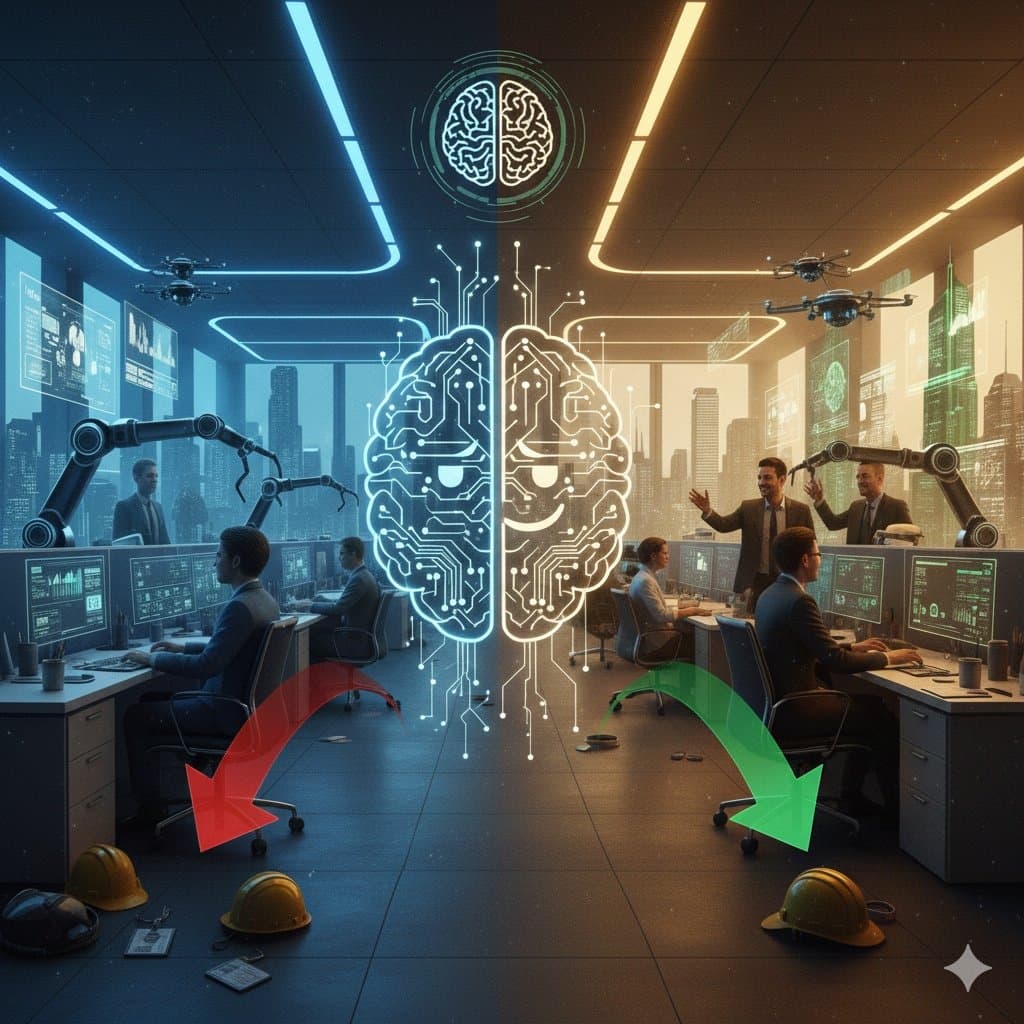
As of January 29, 2026, company announcements show how AI investment can accompany workforce restructuring. Dow announced a plan affecting approximately 4,500 roles, with $600–800 million in expected severance costs. Its target is at least $2 billion in near-term operating EBITDA improvement, partly through AI and automation; that figure includes productivity and growth benefits, not just cost savings. Pinterest’s January 27 SEC filing describes a reduction affecting less than 15% of its workforce and $35–45 million in expected pretax restructuring charges, alongside investment in AI-focused roles and products. Dow’s announcement. Pinterest’s SEC filing.
These moves are not isolated. Challenger, Gray & Christmas recorded AI as a cited reason for 54,836 announced U.S. job cuts in 2025. That measures employers’ stated reasons for planned cuts, not a verified count of workers replaced by AI systems. Amazon also announced reductions affecting approximately 16,000 roles on January 28, 2026, describing a continuation of efforts to reduce layers and bureaucracy. Challenger’s 2025 report. Amazon’s January update.
Hype, Anticipation, or Actual Displacement?
Not every announcement mentioning AI establishes direct technological replacement. A company may be reorganizing, reducing costs, investing in new products, or anticipating future efficiencies at the same time. To assess displacement, distinguish the tasks a system demonstrably performs from a management forecast or a decision to shift spending.
That said, task-level automation is accelerating, particularly in routine cognitive work, e.g., data entry, basic analysis, first-draft writing, compliance checks, and scripted customer interactions. The effect on a whole job depends on how much of its work can be automated and what supervision remains necessary.
Broader Outlook: Net Job Creation Amid Transformation
The World Economic Forum’s Future of Jobs Report 2025 projects 170 million roles created and 92 million displaced by 2030, a net increase of 78 million. These are employer-survey projections across technological, economic, demographic, and other trends—not a forecast of AI alone. WEF’s report summary.
Forecasts describe possible paths, not guaranteed outcomes. Automating part of a job can change its workload without eliminating the position; in other settings, the same capability can reduce staffing. The relevant questions are which tasks change, who gains from higher productivity, and how displaced workers can move into new work.
WEF distinguishes percentage growth from absolute job growth. AI, data, and software roles are among the fastest-growing categories by percentage. Frontline roles such as farmworkers, delivery drivers, and construction workers account for large absolute gains; care and education also grow. WEF’s job-growth comparison.
Routine clerical and administrative work is particularly exposed to automation. The same report emphasizes analytical thinking, resilience, leadership, and collaboration alongside technology skills. Exposure varies across tasks; an occupation label alone does not establish that a job will disappear.
Skills Disruption and the Reskilling Imperative
In WEF’s survey, 77% of employers plan to upskill workers in response to AI, while 41% plan workforce reductions where AI automates tasks. These plans can coexist within an organization. WEF’s AI and upskilling findings.
For workers, the practical goal is to connect AI fluency to useful domain knowledge and demonstrable work. Training should be judged by whether it helps people perform changing tasks or transition into available roles, rather than by an assumed salary premium.
Moving Forward
For individuals: Prioritize AI fluency (using/managing AI tools), continuous learning in high-demand areas (data, AI ethics, domain + tech hybrids), and human-centric skills that complement automation.
For companies: Avoid short-term "replace first" approaches that risk losing institutional knowledge; focus on redesigning workflows, augmenting talent, and responsible deployment.
Policymakers and educators: Scale reskilling programs, update curricula, and support transition safety nets.
AI is not a zero-sum destroyer of jobs but it will be a powerful transformer. The 2025-2030 period will be turbulent, with real displacement in specific roles and sectors, heightened anxiety, and uneven impacts favoring those who adapt quickly. The optimistic scenario combines productivity gains with new occupations, but its benefits are not automatic. Investing in people alongside technology improves the prospects for useful human-AI collaboration while addressing actual displacement.
