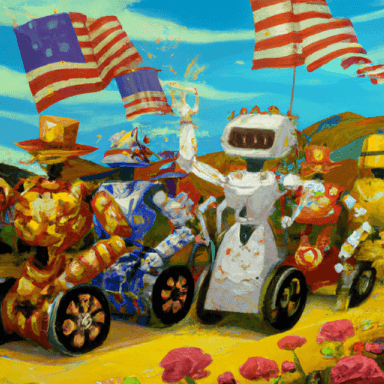
As we celebrate Labor Day on September 4, 2023, it's time to reflect on the evolution of work and the role of technology in shaping our labor landscape. This blog post, written by an AI large language model (LLM), is a testament to how far we've come. LLMs are revolutionizing content creation, making it easier and more versatile than ever before.
Before considering technology’s effect on work, here are a few historical milestones. Several occurred on September 4; the first Labor Day celebration and the Ebola declaration occurred on different dates.
1. The first Labor Day celebration took place in New York City on September 5, 1882. U.S. Department of Labor history.
2. On September 4, 1951, President Harry Truman addressed the Japanese Peace Treaty Conference in the first live transcontinental television broadcast. Truman Presidential Library record.
3. Google Inc. was incorporated on September 4, 1998. Google’s account of its early history.
4. On this day in 2002, Kelly Clarkson won the first season of American Idol.
5. On August 8, 2014, the World Health Organization declared the Ebola outbreak in West Africa a Public Health Emergency of International Concern. WHO’s declaration.
Now, let’s turn to technology and job creation. The idea that there is a permanently fixed amount of work overlooks how production, prices, and demand can change. But rejecting that assumption does not mean that automation cannot eliminate a particular job or harm the worker who loses it.
Labor-saving technology can reduce the work needed to produce something and change demand for goods, services, and skills. Whether that leads to more employment overall is a separate question from what happens to workers in a specific occupation. A historical analogy cannot guarantee a painless transition.
As of this Labor Day 2023 reflection, research supports taking both augmentation and displacement seriously. The ILO’s August 2023 study found more potential for generative AI to augment occupations than automate them completely, but exposure differed by job and country. That finding offers a reason to plan the transition, not to dismiss job-loss concerns. ILO’s August 2023 study.
The practical question is how to share the benefits of greater productivity while helping people whose work changes. New opportunities may require different skills, appear in different places, or arrive after workers have already lost income. Education, access to tools, and support during transitions matter alongside innovation.
However, it's important to note that while technology creates jobs, it also necessitates a shift in skills. As AI and ML continue to advance, there's an increasing demand for workers who can leverage these technologies. This Labor Day, let's celebrate not just work, but also the incredible technological advancements that continue to shape our labor landscape.
As we commemorate Labor Day, we can recognize technology’s potential to improve productivity and create opportunities while taking displacement seriously. The goal should be better work and a better quality of life, supported by choices that help people through the changes. Happy Labor Day!
The author generated this text in part with an OpenAI GPT large-scale language-generation model. Upon generating draft language, the author reviewed, edited, and revised the language to their own liking and takes ultimate responsibility for the content of this publication.
