
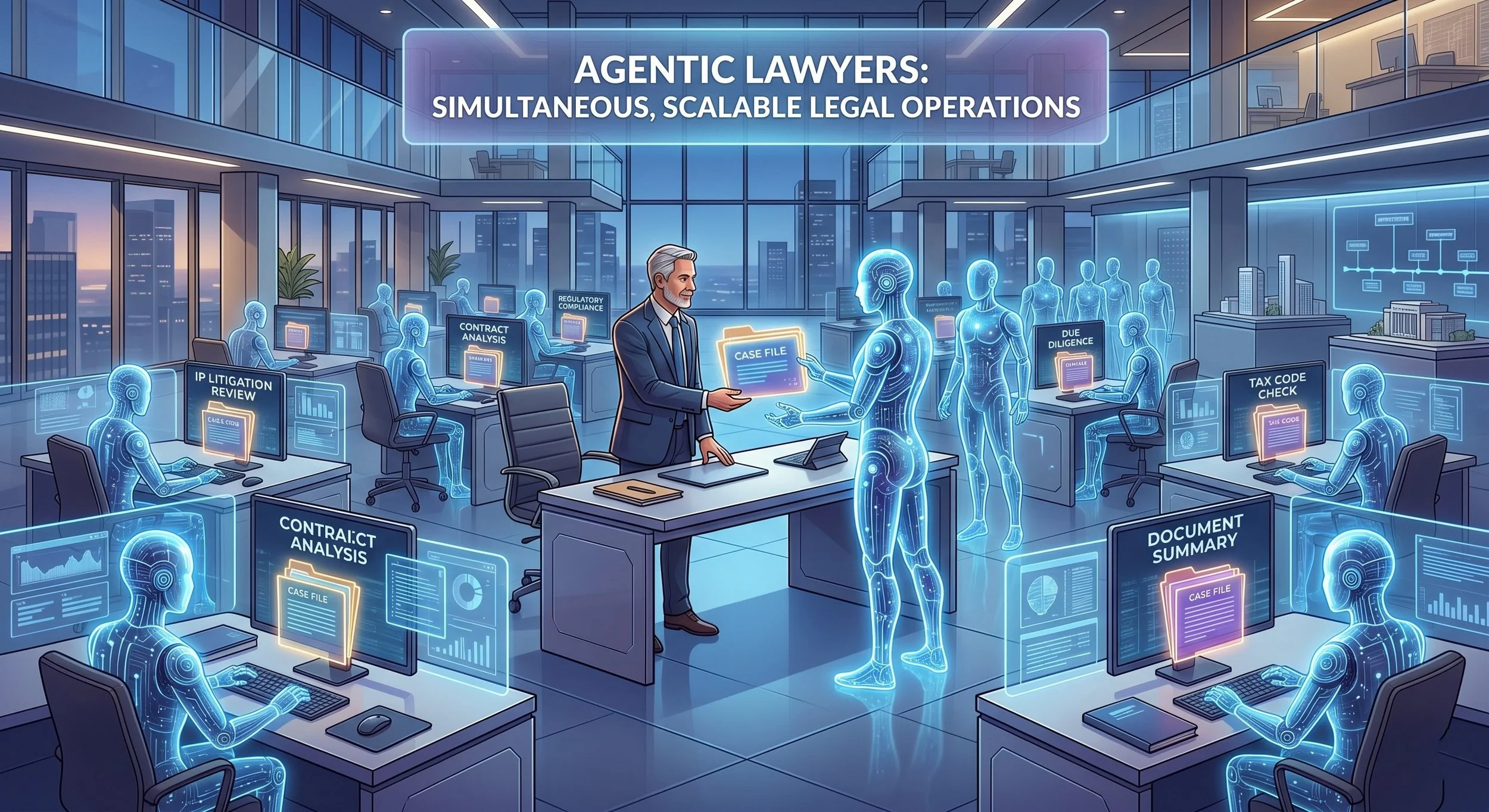
What is an Agentic Lawyer
A lot of people have asked me about agentic lawyers. They want to know what is an agentic lawyer and how might a law firm use agentic lawyers. This video hopes to answer those questions. This is an application that I have been working on, with the concept of agentic lawyers at the forefront of what I'm trying to build. I hope you like it.

The AI Inflection Point the Legal Profession Can No Longer Treat as Theoretical
The current wave of AI development is significant not because it makes lawyers incrementally faster, but because it is beginning to perform the same cognitive work lawyers have historically sold as expertise. The shift is from assistance to execution. That is what makes this moment more consequential than prior waves of legal technology.

March 2026’s AI Launch Wave: What Lawyers Should Make of GPT-5.4, Claude Sonnet 4.6, Gemini 3.1 Pro, Grok 4.20, GLM-5, MiniMax M2.5, and the DeepSeek Question
Lawyers should treat frontier-model launches the way they treat major appellate decisions: not as curiosities, but as signals. The firms and legal departments that follow these developments closely will help shape the next generation of AI governance standards, licensing terms, regulatory arguments, and liability theories. The ones that do not will inherit rules written by others. Staying informed on AI is no longer optional for lawyers. It is rapidly becoming part of competent practice.

The Evolving Role of Artificial Intelligence in National Security
Over the past 48 hours, significant shifts in U.S. government policy toward AI providers have captured widespread attention. These changes involve the blacklisting of one major AI company and a pivot to another for defense collaborations, all amid reports of AI's involvement in international military operations. This post examines these events, their implications for ethical AI development, and the public discourse surrounding them.

Anthropic's Enterprise Expansion: Advancing Claude Cowork with New Plugins and Integrations
On February 24, 2026, Anthropic announced a significant update to its Claude Cowork platform, marking a key step in the development of agentic AI for enterprise environments. This release introduces a comprehensive set of plugins, connectors, and enterprise-grade features designed to embed Claude directly into daily workplace workflows and enhance productivity across various knowledge-based roles.

The Societal and Economic Ripple Effects of AGI: A 2026 Perspective
If AGI reaches the point where it can do most cognitive tasks that pay the bills for the modern middle class, then we will be forced to confront something we have avoided saying out loud.
The lump of labor fallacy may stop being a fallacy, at least for a period of time.

Should AI Conversations Be Privileged? Balancing Privacy, Policy, and the Law
Users often treat these AI tools as advisors, sharing intimate details and seeking guidance. This raises a novel question, “Should communications with an AI be protected by a legal privilege, akin to attorney-client privilege or doctor-patient confidentiality?” Recent developments suggest courts are reluctant. A federal court in United States v. Heppner (S.D.N.Y. Feb. 6, 2024) held that conversations with an AI tool (Anthropic’s Claude) were not covered by the attorney-client privilege. Despite this landmark decision, there are arguments on both sides, doctrinal, ethical, policy, and practical, that are important to consider before this issue is decided.

Kling AI 3.0: Revolutionizing Video Creation – Everyone's Now a Director
Released on February 5, 2026, Kling 3.0 promises to democratize filmmaking, turning complex video production into an accessible tool for creators everywhere. With features like native 4K output, multi-shot sequencing, and integrated audio, it's positioning itself as the "AI Director" we've all been waiting for.

AI Breakthroughs and the Quiet Acceleration of Capability
We are witnessing a series of developments in artificial intelligence that, taken individually, might seem incremental. Viewed together, they tell a different story. These advances point to a steady expansion of machine capability into domains once thought firmly human. Scientific reasoning, biological understanding, and even primary medical care are now being reshaped by systems that learn, infer, and act at scale.
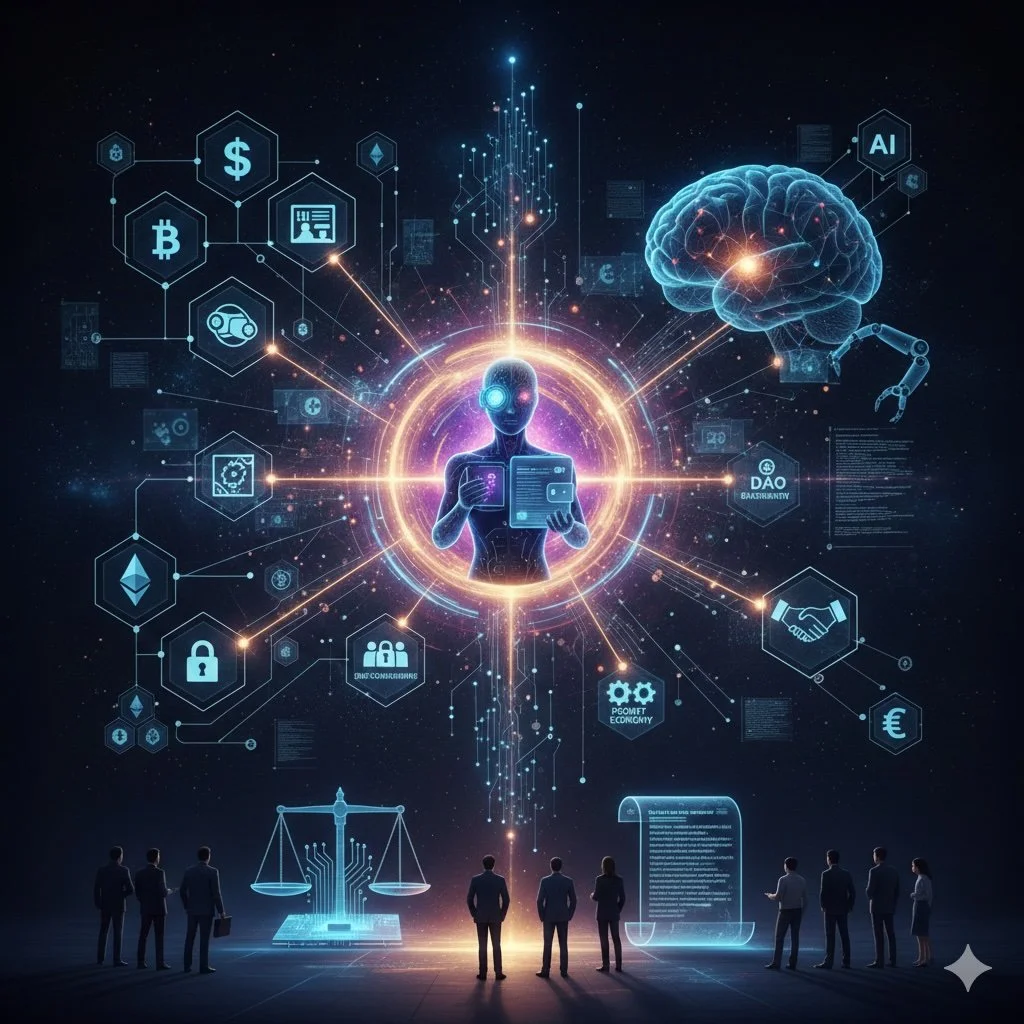
Crypto and AI: Converging, Complementary Technologies
Both cryptocurrency (“crypto”) and artificial intelligence (“AI”) have upended conventional wisdom in their respective domains. Crypto reimagined trust and value exchange by replacing centralized intermediaries with code and distributed consensus. AI, meanwhile, is redefining intelligence and automation, tackling tasks once deemed exclusive to human cognition. Individually, each technology is disruptive; together, their convergence is creating unprecedented paradigms. This intersection of decentralized finance and autonomous intelligence holds immense promise (and complex challenges) for lawyers, policymakers, and tech enthusiasts alike. It’s a realm where questions of trust, identity, governance, and innovation all collide.