Clarification — September 11, 2026: The AlphaGenome section now distinguishes molecular predictions and research hypotheses from experimentally established causation or clinical validation.
We are witnessing a series of developments in artificial intelligence that, taken individually, might seem incremental. Viewed together, they tell a different story. These advances point to a steady expansion of machine capability into domains once thought firmly human. Scientific reasoning, biological understanding, and even primary medical care are now being reshaped by systems that learn, infer, and act at scale.
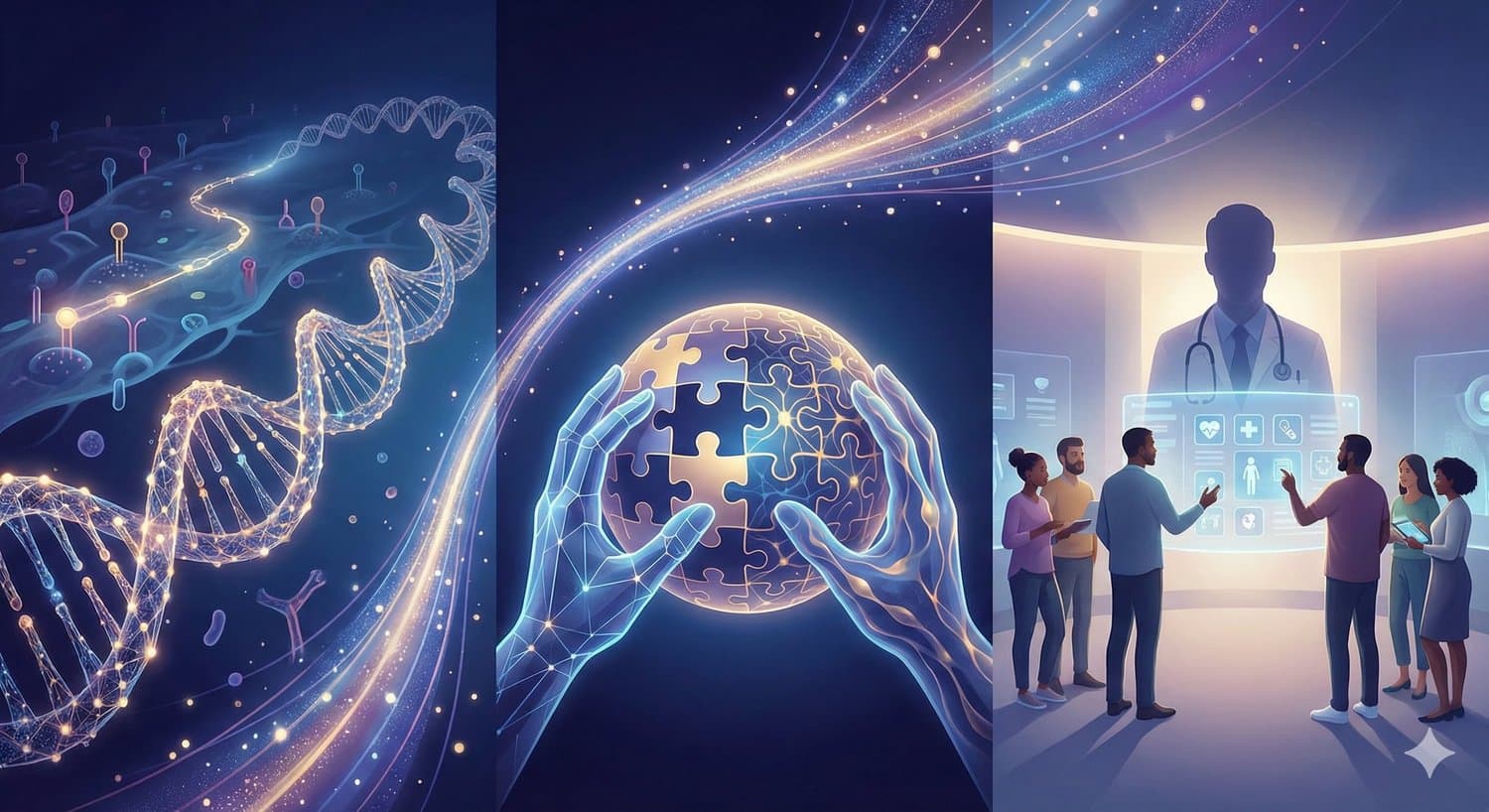
Three recent developments illustrate this shift particularly well. Each highlights a different dimension of AI’s growing role in how knowledge is created, decisions are made, and services are delivered.
Reading the Genome at Scale
DeepMind introduced AlphaGenome in June 2025, and the research was published in Nature in January 2026. It predicts molecular properties from DNA sequences up to one million base pairs long and estimates variant effects by comparing altered and unaltered sequences. Its scope includes gene regulation and RNA splicing. This makes it useful for investigating non-coding DNA, which includes important regulatory regions.
Those outputs help researchers prioritize variants and formulate explanations to test. A model prediction alone does not establish that a mutation causes a disease; experimental evidence and biological context remain necessary to evaluate a proposed mechanism.
In one cancer-associated example, DeepMind reported that AlphaGenome reproduced predictions consistent with a previously known TAL1-related mechanism. That demonstrates a research use; it does not establish that the model can reliably separate every tumor-driving mutation from incidental mutations or validate a treatment.
The model was trained using public human and mouse data covering multiple molecular processes. DeepMind describes the predictions as intended for research and says they have not been designed or validated for direct clinical use. The reported limitations include distant regulatory interactions and cell- or tissue-specific patterns.
The potential is still substantial: researchers can examine more candidate explanations and choose experiments more efficiently. The value lies in connecting useful predictions to expert interpretation and testing, rather than treating a generated result as a completed biological discovery.
Reasoning Beyond Pattern Matching
Another important development is the resurgence of neuro-symbolic AI. For years, deep learning models excelled at pattern recognition but struggled with transparent reasoning. Symbolic systems, by contrast, were interpretable but brittle. Neuro-symbolic approaches combine these two traditions.
Recent research shows that hybrid systems outperform purely neural models on tasks requiring logical deduction and abstraction. In controlled benchmarks involving mathematical reasoning and structured problem-solving, neuro-symbolic systems achieve higher accuracy while requiring less training data.
Systems like AlphaGeometry demonstrate the practical value of this approach. By pairing neural networks with symbolic verification engines, they solve problems at the level of international mathematics competitions. This same architecture is increasingly relevant to domains where correctness and explainability matter more than stylistic fluency.
For high-stakes applications such as medicine, defense, and law, this matters. Decisions in these fields must be explainable, auditable, and defensible. A system that can articulate its reasoning is fundamentally different from one that merely produces plausible outputs.
The broader implication is that AI is no longer limited to statistical imitation. It is beginning to reason in ways that align more closely with human conceptual frameworks, while retaining machine-level speed and scale.
Primary Care Without the Waiting Room
The third development points to a different kind of transformation. Lotus Health has introduced an AI-driven primary care platform that provides free, continuous medical access across the United States. Supported by significant venture funding, the system offers consultations in dozens of languages and operates around the clock.
The model is notable for its structure. AI handles initial intake and analysis, but every diagnosis, prescription, and referral is reviewed by a board-certified physician. This hybrid approach addresses concerns about hallucinations and clinical safety while dramatically expanding access.
For millions of Americans who lack consistent primary care, the implications are substantial. Routine medical guidance becomes immediately available, unconstrained by geography or scheduling. While the long-term business model remains to be seen, the direction is clear. AI is not merely assisting clinicians. It is reshaping how care is delivered.
A Pattern, Not an Anomaly
Taken together, these developments reveal a consistent pattern. AI systems are moving deeper into domains defined by complexity, judgment, and expertise. They are not replacing human professionals outright. Instead, they are compressing the cost of cognition and expanding the availability of expert-level assistance.
This is the same dynamic explored throughout Infinite Counsel. When expertise becomes abundant, its economic and institutional role changes. Genomics, reasoning, and healthcare are simply early examples of this shift.
As these systems mature, the central question is no longer whether AI can perform complex tasks. It clearly can. The question is how institutions adapt when high-quality analysis and guidance are no longer scarce.
The answer will not arrive all at once. But the trajectory is increasingly difficult to ignore.
