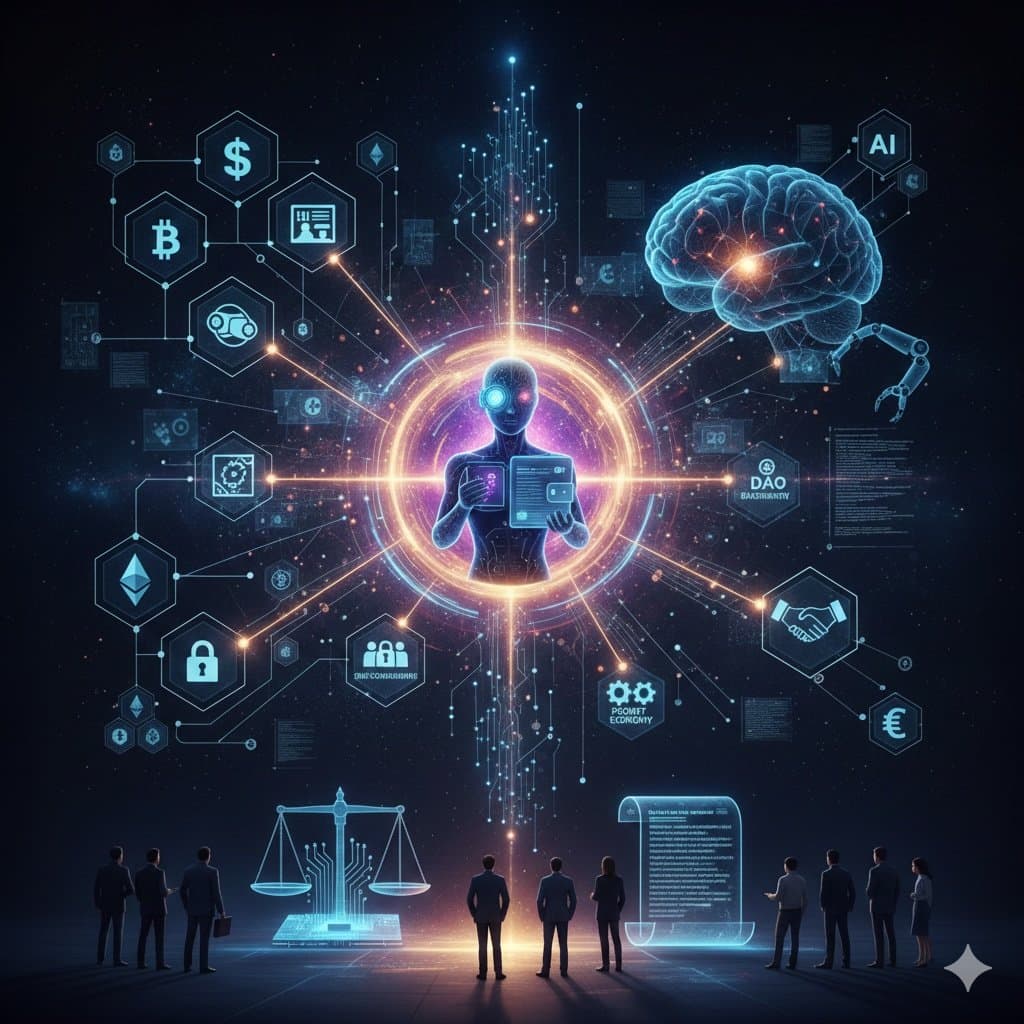
Both cryptocurrency (“crypto”) and artificial intelligence (“AI”) have upended conventional wisdom in their respective domains. Crypto reimagined trust and value exchange by replacing centralized intermediaries with code and distributed consensus. AI, meanwhile, is redefining intelligence and automation, tackling tasks once deemed exclusive to human cognition. Individually, each technology is disruptive; together, their convergence is creating unprecedented paradigms. This intersection of decentralized finance and autonomous intelligence holds immense promise (and complex challenges) for lawyers, policymakers, and tech enthusiasts alike. It’s a realm where questions of trust, identity, governance, and innovation all collide.
Crypto’s decentralized infrastructure can add records of provenance and authorization, although those records alone do not establish accuracy, fairness, or identity outside the system, and, conversely, AI can enhance crypto through smarter user experiences, fraud detection, and scalability improvements. There exists the potential for a philosophical and technical cohesion between the two, for example, the shared reliance on public/private key cryptography to establish identity and even “proof of humanity.” The emerging concept of AI agents wielding crypto wallets to autonomously manage value, will create an “agent economy.” The conceptual and ethical implications (from misuse of private keys to AI governance and energy impacts) are enormous. Numerous projects are merging AI and blockchain, including mature initiatives and cutting-edge startups. These examples span decentralized compute networks, autonomous agent payments, data marketplaces, zkML (zero-knowledge machine learning), security, gaming, DeFi, healthcare, and governance. A nuanced picture of this fast-evolving landscape is already taking form.
Decentralized Trust for AI: What Crypto Can and Cannot Verify
AI’s rapid advance has brought well-known trust challenges. How do we know what data an AI model was trained on? Can we audit its decisions? Who is accountable if it discriminates or errors? Traditional AI systems operate as opaque silos, often hoarding data and model weights under corporate control, which makes provenance and transparency elusive. This opacity fuels concerns about bias, manipulation, and even liability for AI-driven outcomes. Crypto’s ledger and signature tools can help record actions. Their reliability still depends on inputs, key security, and governance.
A blockchain can record declared data sources, model versions, and actions in a shared ledger. That can help an auditor check whether a record has changed. It does not independently establish that an input was true, a record was complete, or a training example caused a particular answer. NIST’s Blockchain Technology Overview describes this limitation as the oracle problem: outside information can be wrong even when the ledger records it faithfully. Provenance can support an investigation; explaining a model’s behavior and evaluating bias require additional methods. NISTIR 8202, section 7.3.
Self-sovereign identity (SSI) and related blockchain-based identity tools further bolster AI trust. AI agents, or even just AI-generated content, can be cryptographically signed by an identity that’s verifiably tied to a real organization or person. Consider the burgeoning problem of deepfakes and AI-generated fraud: one solution is a system like Proof’s “Certify” platform, which cryptographically signs all media and data to create a record that can help verify provenance and integrity. A video or document stamped in this way can carry a signed record of its asserted origin, mitigating the risk of forgery. Proof describes this approach as a way to address AI-driven impersonation; a signed origin record does not establish that the content itself is true. Even Sam Altman of OpenAI has warned of an “impending crisis” in identity verification as AI can now defeat many traditional checks. Blockchain offers a way to re-establish trust through math and code rather than human judgment alone.
Decentralized identity is not just about content; it’s also about the entities (human or AI) interacting online. Proof of Personhood protocols, which use cryptography to prove that a user is a unique human being, are emerging as crucial complements to AI in the wild. When AI bots can mimic humans at scale, being able to verify “humanness” becomes vital for online communities, elections, and commerce. Projects like Worldcoin’s World ID use custom biometric hardware (the “Orb”) and zero-knowledge proofs to give users a private digital passport of personhood, so that, for example, a social network or forum can ensure each account represents a real individual without revealing their personal data. The goal is to preserve an even playing field in the age of AI, and create a “humanness layer” for the internet. Public/private key cryptography underpins these systems: each person (or agent) gets a unique cryptographic identifier they control. A corresponding private key can produce signatures that others verify with the public key. This same mechanism can be extended to AI agents, granting them identifiable reputations. The International Association for Trusted Blockchain Applications (INATBA) noted that SSI enables autonomous AI agents and provides continuous, verifiable credential checks, supporting credential and data-integrity checks; that is not a substitute for separately evaluating algorithmic bias. Decentralized identity and blockchain credentials serve as a trust anchor for AI by providing claims and verification mechanisms about an identified entity, subject to the credential issuer and verification process.
For lawyers and policymakers, a verifiable record can help reconstruct who authorized an action, which model version was used, and what information was recorded. That may be useful evidence, but it does not by itself make an AI system explainable, settle liability, or establish compliance with privacy or AI law. Public records can also create privacy questions. The relevant assessment is specific: what is recorded, who can inspect it, how reliable are the inputs, and what rights and remedies remain available?
Shared Foundations: Identity, Cryptography, and Autonomy
Beyond practical fixes, the crypto and AI worlds share a deeper philosophical and technical cohesion. Both hinge on the idea of autonomous agents operating in complex environments. Crypto is grounded in economic consensus, while AI is grounded in cognitive tasks. And both rely on cryptography as a foundational tool: in crypto, to secure transactions and data; in AI, increasingly, to secure models, verify outputs, and protect data privacy. This shared DNA is most evident in the concept of digital identity and signatures, which play a pivotal role in tying actions to actors in a verifiable way.
At the heart of blockchain is the public/private key pair. This key pair essentially creates an identity system where control of the private key enables a signature associated with its public key; that does not by itself establish the signer’s legal identity or ownership rights. The same concept is being applied to AI systems and agents. Every AI agent can be assigned a cryptographic identity (a decentralized identifier, or DID) that it uses to sign its actions or transactions. This means an AI bot or service can have a reputation and interact on equal footing in a blockchain-based economy. “Self-sovereign identity: Each agent is assigned a cryptographically unique decentralized identifier, allowing agents to manage their own identities without centralized control,” as one identity management firm describes. In practical terms, an AI service could prove it is the one that produced a certain output by signing it (preventing impersonation by fake AIs), and users or other agents could verify that signature against the agent’s DID document on a blockchain. Decentralized identity thus enables “agentic AI,” and allows for independent AI agents that can authenticate themselves and interact across ecosystems.
This plays into the “proof of humanity” aspect mentioned earlier. Public key cryptography, combined with identity-verification methods, can support a link between a human and a digital credential, which is critical when AI can generate limitless fake personas. Lawyers might note that this begins to establish a framework for digital personhood: just as corporations have legal identity, we are crafting ways for AI agents (or human digital twins) to have cryptographic identity. Some jurisdictions are even contemplating forms of “electronic personhood” for autonomous systems (though that remains controversial). What’s clear is that without robust identity, both AI and crypto flounder: crypto succumbs to theft and Sybil attacks, AI succumbs to spoofing and mistrust. The solution space for both converges on cryptographic identity proofs.
Another philosophical commonality is the drive for decentralization and avoiding single points of failure/control. Crypto’s ethos is obviously decentralized. AI’s current trajectory, however, has been toward centralization (a few Big Tech companies control the most powerful models and infrastructure). Decentralizing AI, whether via distributing model training (as in projects like Bittensor and Gensyn) or via federated learning on user devices, has become a rallying cry for those worried about an AI monopoly. The public/private key infrastructure and blockchain governance mechanisms offer a ready-made toolkit to coordinate decentralized AI development. For example, a network of AI model providers can use a blockchain to coordinate contributions and rewards (ensuring no one party dictates the rules). And the decisions can be made via token-weighted voting (a DAO for AI governance) or other decentralized governance models, rather than behind closed doors. This is in line with the vision that “open networks where anyone can create, train, and access AI” are essential amid the concentration of AI power. The decentralist philosophy of crypto is entering the AI space to counterbalance giants like Google and OpenAI by leveraging the consensus and governance models of blockchain.
Zero-knowledge machine learning can make a defined computation verifiable without exposing all of its inputs. For example, EZKL describes proofs that a specified model was executed or that a benchmark was computed against committed model and data inputs. The proof’s scope matters: verifying execution is not the same as establishing that the input data is true, the benchmark represents real-world performance, or a model is fair. Nor does an inference proof by itself establish which private data was or was not used in training. EZKL’s technical overview.
A tangible illustration is in public key cryptography enabling “proof of life” or “proof of human” for interactions. Suppose in a future online court proceeding or contract negotiation, one party wants to ensure the counterpart is a human, not an AI deepfake. A solution might be requiring a cryptographic credential (a verifiable credential) issued to real humans. This essentially creates a digital certificate of personhood, which can be checked on a blockchain before proceeding. It’s not hard to imagine courts or e-signature platforms building in such checks, given the rise of AI-generated identities. Decentralized identity is one proposed way to supply authentication, consent, and delegated authority for AI systems. The Indicio report puts it succinctly: “AI systems need decentralized identity… Only decentralized identity provides the authentication, consent, delegated authority, structure, and governance needed for AI to deliver value.” That is Indicio’s argument for its preferred architecture, not proof that decentralized identity is the only workable approach. Any implementation still needs to be evaluated for its actual controls.
Conceptually, both crypto and AI empower autonomous agents. Crypto is financial. AI is intellectual. A smart contract on Ethereum is an automaton that holds and moves funds by its code. An AI agent is an automaton that perceives and acts by its programming. Marrying the two yields the vision of DAOs populated by AI agents, or smart contracts that upgrade themselves using AI, or AI assistants transacting value on your behalf. The public/private key serves as the brain-to-world interface for these agents: an AI’s “wallet” is effectively its identity and agency in the crypto realm. We are moving toward decentralized organizations where AI agents outnumber humans to automate voting and task execution while retaining necessary oversight. Sound far-fetched? It’s already being trialed: blockchain projects have deployed simple AI moderators for proposal filtering, and there are startup experiments with AI DAOs that manage investment portfolios. Legally, this forces a reckoning with questions like “Can an AI agent be a party to a contract if it has a recognized cryptographic identity?” and “How do we assign responsibility when autonomous agents interact?” Those questions will define a new frontier of tech law. But the essential building blocks, things like secure digital identity, transaction logic, and audit trails, are coming into place through the crypto+AI convergence. The same cryptographic keys that protect billion-dollar Bitcoin wallets could soon authorize an AI agent to hire or trade while creating an immutable on-chain record for regulators and the public.
AI Agents with Wallets: A Glimpse of Autonomous Economies
One of the most intriguing outcomes of blending AI and crypto is the rise of AI agents that can autonomously manage and transfer value. In sci-fi and futurist circles, people have long imagined intelligent machines participating in the economy, e.g., “robot landlords,” AI-driven businesses, machines paying each other for services, etc. We are now seeing the early real-world instances of this in the form of AI agents equipped with crypto wallets. This development is poised to redefine commerce and services: machines that not only think, but also pay and get paid.
A recent milestone came from Fetch.ai, which introduced what they dub the world’s first AI-to-AI payment for real-world transactions. In a live demonstration, one personal AI agent coordinated with another to plan a dinner for their human users. The AI Agent found a restaurant, made a reservation via an API, and then settled the bill autonomously while both humans were offline. The agents used Fetch’s “ASI:One” platform and integrated payments via Visa, USDC stablecoin, and the network’s FET token on-chain. In effect, my AI can pay your AI for something. This vision of “agentic payments” has the potential to create an AI-first economy. As Fetch’s CEO Humayun Sheikh put it, “By enabling AIs to transact on our behalf, we’re creating a new era where intelligent agents execute real-world value transfers without waiting for us to intervene… turning opportunities into experiences and purchases automatically.” This scenario was no longer theory: the AI agents actually secured a dinner reservation and paid for it, all while humans were hands-off.
For an agent-payment system, authorization and spending controls are as important as the payment mechanism. A user might delegate a limited budget for a defined task, with additional approval required for larger or unusual transactions. Developers need to decide which credentials the agent receives, how they are protected, and how permissions can be revoked. Recording a payment does not guarantee that the purchase was authorized, useful, or secure; those properties depend on the surrounding system.
The implications of AI-driven machine-to-machine payments are vast. Consider IoT devices. For instance, imagine a world where your smart fridge not only detects it’s low on milk, but also autonomously orders and pays for a grocery delivery. Or an AI-powered ride-sharing vehicle that can pay tolls and charging fees on its own. Or clusters of AI microservices on the cloud that dynamically charge each other (in crypto) for using data or algorithms, forming an open marketplace of AI capabilities. In each case, blockchain provides the settlement layer and security, while AI provides the autonomous decision-making. We move from just talking about machines as economic agents to actually seeing them sign transactions with cryptographic keys and exchange digital assets.
This raises some profound legal and ethical questions. If an AI agent misuses funds or breaches a contract, who is liable? The human owner? The developer of the AI? Or do we start to consider the AI agent as having a form of legal agency? Those discussions are in their infancy, but we can draw analogies to existing structures. For instance, one could require that every AI agent is tied to a legal entity (a company or an individual) responsible for it. This would look much like the way a corporation (a fictional person) ultimately keeps real people accountable. Lawyers might also explore the idea of “algorithmic escrow”: requiring AI agents to use smart contracts that enforce certain rules (like arbitration or automatic refunds under conditions). In any case, creating transparent records of an AI’s economic actions (on a blockchain) will be invaluable for resolving disputes.
Security is another worry: an AI agent’s private key is a valuable target. If stolen, the thief effectively steals the agent’s identity and funds. Solutions might include hardware security modules for agents, multi-signature schemes (where, say, the AI and its owner must cosign large transactions), or time-locked transactions the owner can veto. Fetch’s approach of strict spending limits and optional user confirmations is one practical safeguard. Moreover, cryptographic accountability means every action is signed. So, even if an AI goes rogue, or is compromised, it’s traceable and evidence is preserved.
On the upside, autonomous agents could create enormous efficiencies. They operate 24/7, make decisions in milliseconds, and can handle micro-transactions that humans wouldn’t find worthwhile. Blockchain-based payment channels or layer-2 networks might be used by swarms of AIs to settle thousands of tiny payments per second (imagine an AI paying a few cents to another for 10 seconds of GPU compute time). This machinic economy could optimize resource utilization in ways our current systems can’t. For example, unused compute, storage, or even physical assets (like idle cars) could be automatically leased out by AI agents to those who need them, with all payments and terms enforced by smart contracts.
Policymakers will need to pay attention to AI agents engaging in commerce. Does a transaction between two AI agents count as a contractual agreement? How do consumer protection laws apply when an AI, not the consumer, made the purchase? There may be a need for new legal definitions or at least new interpretations. On the flip side, these autonomous systems could also enhance compliance if designed correctly. For instance, an AI agent could be programmed to automatically collect and remit taxes on its transactions (it has no desire to cheat if aligned properly).
The bottom line: AI agents with wallets represent the blending of intelligence and economic agency. We’re empowering code not just to think and decide, but to directly act in the financial realm. It’s both exciting and a bit unsettling. Fetch.ai presents its demonstration as an example of a controlled, user-approved transaction; that example does not establish the safety of every deployment. The result was convenience: a dinner planned and paid for without hassle. Scale that up, and we might find a lot of mundane commerce can be offloaded to our personal AIs, freeing humans for higher-level decision-making. We must ensure, however, that the legal and security frameworks keep pace, so that this convenience doesn’t come at the cost of chaos or unfairness. If we succeed, the payoff is a more fluid economy where intelligent agents transact seamlessly, driving efficiency and possibly even unlocking new business models that were impossible when only humans sat at the table.
The deep intersection of crypto and AI is more than the sum of its parts. It is a synthesis of trust and intelligence, two pillars of modern society. Crypto provides the trustless frameworks and incentive structures; AI provides the adaptive intelligence and automation capabilities. Together, they offer components for systems that aim to combine autonomy with accountability, transparency, and privacy. Achieving those properties requires more than connecting a model to a ledger. For lawyers and policymakers, this convergence heralds a new digital paradigm to grapple with. It challenges us to rethink legal personhood, liability, compliance mechanisms, and even the nature of work and contracts (when your client might be an AI or when a DAO with AI members enters agreements). Yet it also offers tools to achieve policy goals: greater financial inclusion through smart automation, enhanced auditability and fairness in algorithms, and novel ways to empower individuals with control over their data and digital agents.
