Is This Time Different?
We find ourselves on the cusp of a technological upheaval. Throughout history, each revolutionary technology has sparked fears of human obsolescence, only for society to adapt and find new forms of work. Economists have a name for this repeated concern, the “lump of labor fallacy.” The lump of labor fallacy is the mistaken belief that there is only a fixed amount of work to go around. In the Industrial Revolution, mechanized looms threatened weavers’ jobs, and later, computers were said to threaten office workers. Yet time and again, new industries and roles emerged to absorb displaced workers. Productivity soared, living standards rose, and human labor shifted to tasks requiring more skill or creativity. History taught us not to bet against human adaptability. But as we enter the age of artificial intelligence, we must ask, “Is this time different?”
Past Revolutions Amplified Human Physical Ability
To understand why many say the AI revolution may be unprecedented, we should recall what made past revolutions different. In each prior wave of innovation, machines helped humans overcome our physical limitations. Steam engines, electricity, and assembly lines magnified physical power. Later, computers accelerated calculations and record-keeping. These technologies automated physical and routine tasks, enabling a single individual to perform the work of many with greater speed, reach, and strength than any human could achieve alone. For example, the Industrial Revolution’s machinery essentially made raw strength less relevant to economic production. A single steam shovel could out-dig dozens of laborers; a factory spindle could out-spin scores of handloom weavers. Crucially, however, these machines never replaced the need for human intellect. Instead, they leveraged human intellect to compensate for human shortcomings. These machines took over manual toil and repetitive tasks, but they still required people at the helm for supervision, judgment, and innovation. Humans remained the ultimate problem-solvers, finding new jobs in designing, managing, and improving the machines. The fears of mass permanent unemployment proved unfounded as labor shifted from farm fields and factory floors to offices, services, and creative professions. The pattern held. When one kind of work was automated, other work arose. The new work leveraged our uniquely human cognitive abilities, like critical thinking, empathy, and complex decision-making. This is why the lump of labor fallacy became a staple of economic thinking. Time after time, automation changed how we work, but not whether we work. Our capacity to learn and adjust kept us indispensable.
The AI Revolution Challenges Human Intellectual Dominance
What makes the current AI revolution different is that, for the first time, machines are encroaching on the very domain that makes humans the apex species, our intelligence. Unlike a steam engine or a mechanical loom, modern AI doesn’t just multiply our physical ability, it challenges our cognitive supremacy. Humanity’s position as the apex species has never been due to physical hegemony or sheer strength; it’s due to our brains, our ability to reason, use language, invent, use tools, and solve novel problems. Now we are building machines that can reason, use language, use tools, invent, and solve problems. As AI pioneer Geoffrey Hinton starkly observed, “In the Industrial Revolution, we made human strength irrelevant. Now, we’re making human intelligence irrelevant, and that’s very scary.” His point is that AI is poised to automate not just physical work or simple tasks, but the thinking and analysis that knowledge workers (like lawyers, doctors, accountants) have long believed to be uniquely human.
Even in its current early form, AI is demonstrating skills that rival human professionals. Today’s generative AI models can draft coherent essays, write computer code, and carry on complex conversations. AI can sift through vast databases of case law in seconds and produce legal arguments or business advice in fluent natural language. Not long ago, the idea of a computer passing a law school exam or drafting a contract was science fiction. Now it’s reality. These AI systems aren’t perfect, but they are improving rapidly. Each iteration comes closer to the reasoning ability of a human expert. We are witnessing machines beginning to perform the very cognitive tasks that we once assumed only trained humans could do.
This raises a profound question. If machines can eventually think as well as we can, or even better in some respects, what remains that is exclusively ours? Optimists argue that AI will be just another tool, taking over drudgery and freeing us to pursue higher pursuits, much as past inventions did. Skeptics worry that there may not be a new category of “higher” work left for us, if AI can do almost anything we can. For the first time, we face the possibility that the lump of labor fallacy might stop being a fallacy. Automation could broadly outpace the creation of new human roles. We do not know where that tipping point is, but the very fact we are asking these questions signals how different this moment feels.
The Singularity
We are approaching a technological singularity, the hypothetical point where AI doesn’t just match human intelligence but far exceeds it and begins improving itself at an exponential rate. In theory, an AI that becomes smarter than us could rapidly become vastly smarter, iterating on its own designs beyond human comprehension. Once that happens, the rules of the game change completely. Such an AI could conceivably solve problems or make decisions in seconds that would take humans years, potentially remaking entire industries (including law) faster than our institutions can adapt. While this may sound like science fiction, it is taken seriously by many leading minds in tech. Prominent AI researchers and CEOs have openly speculated that we might reach at least the brink of such a singularity within our lifetimes. Some believe we have already entered the singularity. Whether or not one believes these bold predictions, they underscore a key point, the current AI revolution is not “just another” industrial or digital revolution. We are venturing into uncharted territory for our species. We are talking about creating an intelligence that could one day compete with or surpass our own. That simply has no precedent in human history.
The Legal Profession at a Crossroads
For lawyers in particular, the rise of AI strikes at the core of our profession. The legal field has always been about applying human judgment and expertise to solve clients’ problems. Over centuries, law has weathered many technological shifts and disruptions and generally emerged stronger. The printing press gave lawyers easy access to statutes and cases, but it also increased the volume of law to navigate (thus increasing demand for legal experts). The telephone, photocopier, and computer each changed how lawyers communicated and processed information, yet none of these made the lawyer’s judgment or advocacy any less essential. Even the advent of the internet and digital research databases (Westlaw, LexisNexis) simply became powerful tools on the lawyer’s workbench. In each case, technology augmented a human’s ability to practice law; it did not replace the lawyer. Our profession has tended to absorb new tools while maintaining the same fundamental model of human expertise at the center.
AI, however, may be the first technology to fundamentally challenge that model. When a machine can not only fetch cases but also analyze them, not only draft text but also persuasively argue a point of law, we are no longer talking about a mere tool. We are talking about a potential colleague or competitor. This book explores how quickly this is becoming reality. In fact, the inflection point may have already arrived. If an AI can draft a persuasive motion, review discovery documents, or even give preliminary legal advice, then we must ask, “What unique value will human lawyers add in a world of AI-augmented or AI-driven legal services?”
In the pages that follow, we will explore in detail why this AI revolution is so transformative and how lawyers can respond. We’ll break down the fundamentals of modern AI and large language models so that any attorney can grasp what these tools can and cannot do. We’ll look at how AI is already being used in legal practice and how it might soon evolve from a helpful assistant to an autonomous agent handling entire legal tasks. We’ll consider the economic shake-up underway and why the traditional pyramid of partners and associates might be redrawn when “an army of intelligent agents” can perform the work of an army of junior lawyers. Importantly, we will examine the dawn of infinite counsel, what it means when expert legal advice becomes abundant, and how we as lawyers can maintain our relevance and uphold our principles in that environment. Finally, we will explore questions about Artificial General Intelligence and Artificial Superintelligence, contemplating scenarios that, while speculative, are crucial for us to think about. If one day an AI achieves or exceeds human-level cognitive abilities across all domains, how do we ensure the law continues to serve humanity? How do we govern an intelligence smarter than ourselves, and what safeguards and ethics do we urgently need to develop?
The current AI revolution truly is different in kind from what came before. It challenges us in ways no machine ever has. But it also presents an opportunity to reimagine the profession we have dedicated our careers to helping. As we stand at this crossroads, I encourage you to approach the subject with an open mind and a steady resolve. This book is a guide and a conversation about why AI matters to law, how we got here, and how we might chart a path forward. My hope is that Infinite Counsel equips you with the insight and perspective to engage with change not merely as an observer, but as an informed participant in shaping it. Lawyers are, after all, problem-solvers by nature. Now, the world needs us to apply that skill to perhaps the biggest problem (and opportunity) of our time, coexisting and co-working with intelligent machines. The era of AI in law will indeed be different from past revolutions, because it touches the very core of who we are.
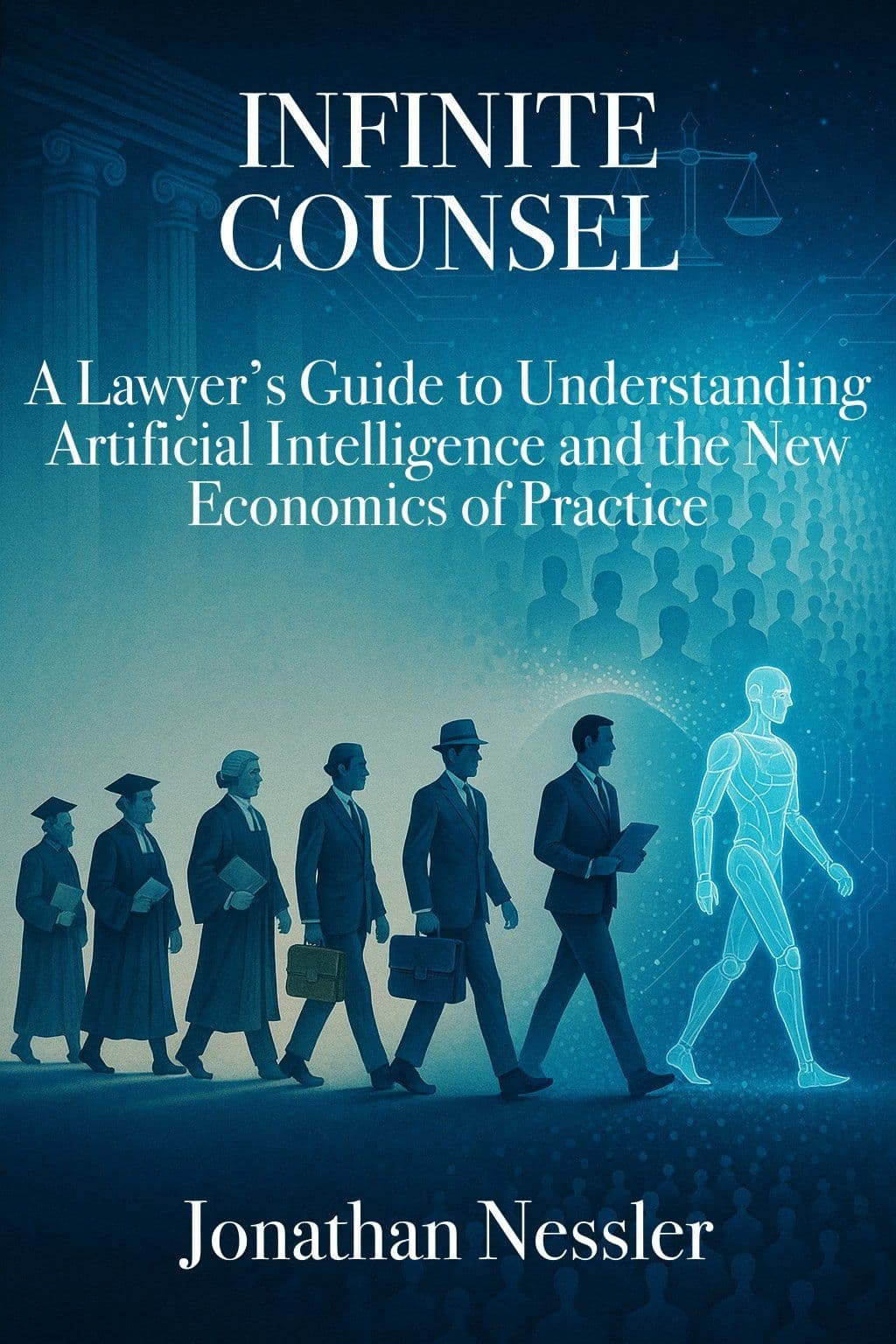
Infinite Counsel is available on Apple Books and Amazon (Kindle and paper back). Select your preferred option below.