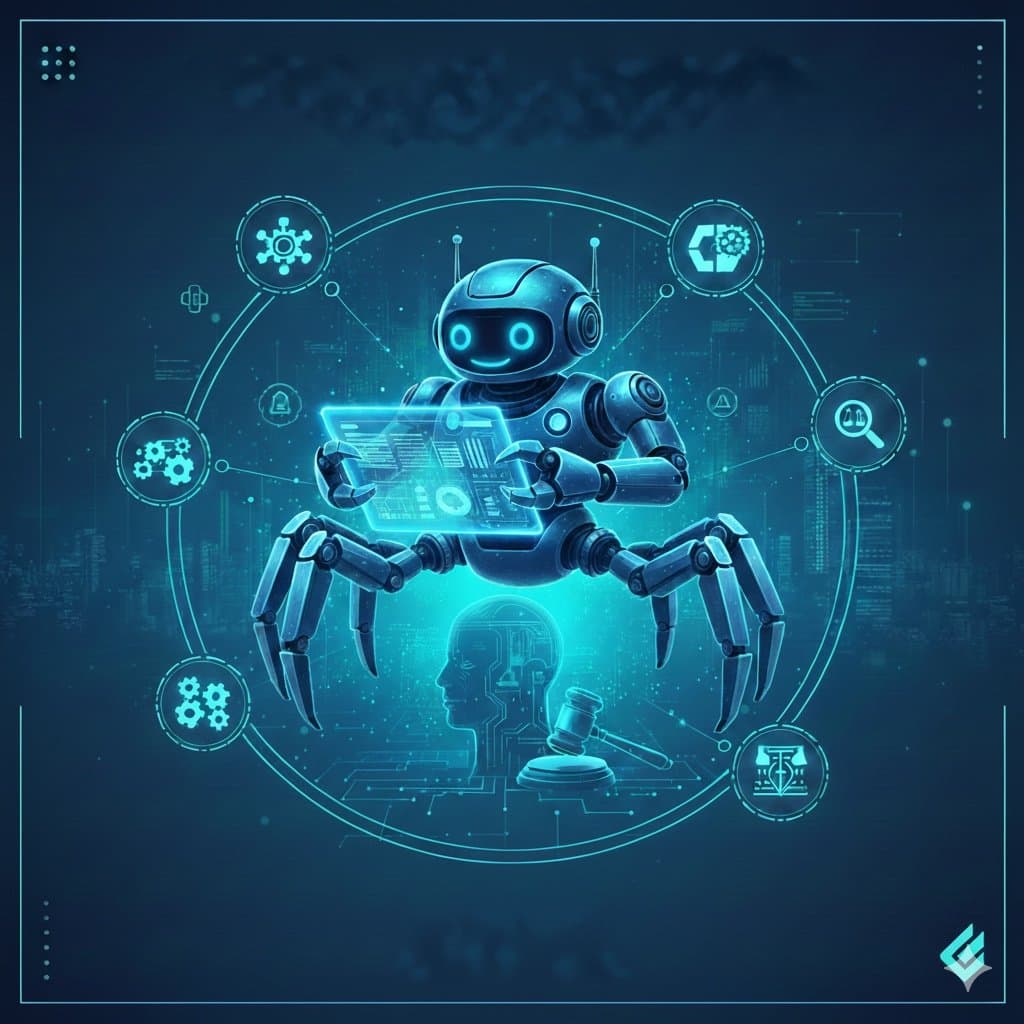
Imagine an AI assistant that can clear your inbox, schedule your meetings, draft emails, book flights, and even improve itself. The agent does all of this while you simply text with it on iMessage, WhatsApp, or Slack. That’s exactly what Clawdbot promises as “the AI that actually does things”, from managing your calendar to checking you in for flights, all through the chat apps you already use. This newly launched personal AI agent is generating a level of excitement rarely seen since the debut of ChatGPT. Clawdbot is stacking up to be an “iPhone moment” for artificial intelligence.
Clawdbot isn’t just another chatbot novelty. Clawdbot represents the dawn of agent-based AI, a technological leap with profound implications. And if you’re a lawyer, law student, or legal professional, this leap shouldn’t just intrigue you; it should galvanize you. The new book Infinite Counsel argues that we’re on the cusp of an “infinite counsel” horizon, where AI agents can deliver competent legal advice at scale. In other words, AI won’t just assist lawyers with research or drafting; it could soon act as a colleague or competitor in performing legal work. Clawdbot offers a thrilling glimpse of that future. Below, we’ll explore what Clawdbot is, why it heralds a new era of AI agents, and why legal professionals must prepare now for this shift in artificial intelligence agency.
Meet Clawdbot: The AI Agent That Does More Than Chat
Clawdbot is a newly launched open-source personal AI Agent that runs on your hardware and can connect to hosted or local models. Created by developer Peter Steinberger (who famously quips, “Apps will melt away. The prompt is your new interface.”), Clawdbot has rapidly gained a cult following among tech innovators. Unlike typical voice assistants or chatbots that are limited to setting timers or answering trivia, Clawdbot is more like a digital intern or colleague living inside your computer. Think of Clawdbot like a remote employee who is willing to work 24/7 and is reachable via simple messages.
At its core, Clawdbot connects a powerful Large Language Model (LLM), such as Anthropic’s Claude or OpenAI’s GPT, to the apps and services you use every day. You interact with Clawdbot through any chat interface you prefer (WhatsApp, Telegram, Slack, even iMessage) as if you were texting a coworker. The difference is that this coworker can actually execute your requests. Tell Clawdbot to “find all emails from client X in the last month and draft responses,” and it will dutifully do so. Ask it to “schedule my meetings for next week around these court hearings,” and it can manage your calendar. In short, Clawdbot is an intelligent agent that acts, not just talks; it is an AI with a degree of autonomy and the ability to perform real tasks in the digital world.
The excitement around Clawdbot comes from this breakthrough capability. When ChatGPT emerged in 2022, it stunned the world by holding intelligent conversations. Clawdbot represents the next step: those conversations now result in actions on your machine. In practical terms, Clawdbot can function like a tireless junior associate or personal secretary who never sleeps. It runs on Windows, Mac, or Linux (many enthusiasts are buying Mac Minis to host it 24/7), stays online to remember context 24/7, and can be reached anytime you need it.
From Chatbot to Colleague: The New Era of Agent-Based AI
Clawdbot is part of a broader revolution toward agent-based AI. In traditional use, AI systems like standard chatbots or legal research tools are passive; they respond to your prompts but lack true agency. With Clawdbot, we see the emergence of artificial intelligence agency: AI systems endowed with agency to take initiative, perform multi-step tasks, and interact with other software on our behalf. This means the AI can make decisions about how to achieve a goal you give it, using tools and finding information just as a human assistant would. We are witnessing AI move from being just a tool to becoming an autonomous teammate.
The concept of an “AI agent” isn’t just jargon; it marks a fundamental shift in what artificial intelligence can do for us. Clawdbot and similar agents can observe the digital environment (your emails, calendar, files, web browser), reason about objectives, and execute actions all on their own. For example, if you instruct Clawdbot to “ensure I never miss a filing deadline,” it could proactively monitor your calendar and court dockets, send you reminders, file draft motions in advance, or even coordinate with other systems; it does this without needing you to prompt every single action. Clawdbot’s users report that it feels like having a proactive colleague: it sends reminders unprompted, keeps an ear on your needs via “heartbeats” (periodic check-ins), and can even surprise you by independently finding ways to help. In other words, we’re now talking about AI that can function as a digital employee or autonomous virtual intern.
You can spawn sub-agents tailored to different tasks: one focused on coding, another on research, and another on scheduling. They can then collaborate autonomously to accomplish complex objectives. This multi-agent orchestration hints at how larger workflows (like a legal case file review or due diligence project) might one day be handled by a team of AI agents working together. The age of siloed apps and manually clicking through software may soon give way to simply telling an AI agent what outcome you want, and letting it figure out the steps. As Steinberger says, “Apps will melt away. The prompt is your new interface.” We will interface with an AI agent that handles the rest. This is the promise of agent based AI, and Clawdbot is a compelling glimpse at it in action.
Inside Clawdbot’s Capabilities: What This AI Agent Can Do
It’s hard to believe Clawdbot’s range without seeing it, but early users are documenting jaw-dropping examples daily. To understand why this intelligent agent has everyone buzzing, consider some of Clawdbot’s core capabilities and real use cases:
- Real-world task execution: Clawdbot doesn’t just generate text; it takes action. It can draft and send emails, manage your Google Calendar, book flights or appointments, handle insurance claims, and process expense reimbursements autonomously. One user even had Clawdbot unsubscribe them from dozens of unwanted emails. The agent dutifully identified subscription links and cleared the inbox clutter on its own. These are the kinds of tedious tasks that plague lawyers and professionals daily, now handled by an AI agent assistant.
- Browser and web automation: Need to gather information or interact with a website? Clawdbot can navigate websites, perform searches, fill out online forms, scrape data, and conduct research with human-like precision. For instance, if you’re a lawyer researching case law or public records, you could instruct Clawdbot to search databases or government sites and extract relevant information while you focus on strategy. It’s like having a research paralegal combing the web for you. In fact, Clawdbot’s web browsing skill means it can even shop online or check you into flights automatically where the site, connected tools, and permissions support those actions.
- System-level control: Because Clawdbot runs on your machine, it has the ability (with your permission) to run shell commands, manage files, and control applications on your system. This is huge. It means Clawdbot can, for example, generate a script and then immediately execute it on your computer to accomplish a task. Developers have used Clawdbot to write code, run tests, and even push updates to GitHub repositories automatically. Imagine instructing an AI to “go ahead and refactor my brief for grammar and Bluebook style, then save a new version,” and it directly edits the Word document on your drive. That level of integration blurs the line between AI output and actual done tasks.
- Knowledge and content generation: Clawdbot uses state-of-the-art language models (often Anthropic Claude for its long-form understanding) to produce human-quality text and even multimedia. It can summarize documents, draft letters or blog posts, generate marketing copy, or create slide presentation outlines on command. But it goes further: multimodal intelligence means Clawdbot can generate images or audio and video content as well. A lawyer can dictate a complex task to Clawdbot via a voice note; Clawdbot will transcribe it, figure out the steps, and execute them.
- Proactive assistance and memory: Perhaps most impressively, Clawdbot doesn’t always wait for instructions. It maintains persistent memory of information saved for later use, which can help it apply your preferences, routine, and goals to later tasks. With this context, it can proactively help you. For example, Clawdbot can monitor traffic and remind you when to leave for court to make it on time. It can keep an eye on your to-do list and gently ping you if you’re falling behind. In the legal realm, consider an agent that knows key deadlines and filings for your cases and nudges you or even drafts needed documents proactively. Clawdbot’s memory and scheduled “heartbeat” checks enable this kind of initiative. Over time, it effectively builds a profile of you, your clients, your writing style, your recurring tasks, and uses that to become an indispensable aide. As one early adopter noted, “it remembers everything I tell her, and can actually do stuff… Absolutely cool.”
In sum, Clawdbot provides one of the clearest examples we have to date of a general-purpose intelligent AI agent. It combines the conversational power of advanced AI models with the practical utility of software scripts and APIs, wrapped in a user-friendly chat interface. It’s like having an all-in-one paralegal, IT assistant, researcher, and secretary who is infinitely scalable. Clawdbot is turning the hype into reality.
Infinite Counsel: AI Agents and the Future of Legal Practice
What does this agent-based AI revolution mean for the legal field? In a word: disruption (but also opportunity). The book Infinite Counsel makes the case that AI agents like Clawdbot foreshadow a world where much of what junior lawyers and support staff do today could be delegated to intelligent machines. The author, Jonathan Nessler, is a trial attorney and legal futurist who paints a vivid picture of the near future: “AI might soon evolve from a helpful assistant to an autonomous agent handling entire legal tasks.”. He asks us to imagine “an army of intelligent agents” performing the work of an army of junior lawyers. Reading that, one can’t help but picture dozens of Clawdbot-like agents rapidly reviewing documents, researching case law, drafting briefs, or managing client intake, all while working concurrently, tirelessly, and at minimal cost. This is precisely what artificial intelligence agency implies: AI empowered to take on responsibilities that once required human judgment and labor.
Importantly, Infinite Counsel doesn’t frame this as science fiction or distant speculation because it recognizes that the inflection point is already upon us. Even in its early form, AI is demonstrating it can draft coherent legal arguments, pass law school exams, and analyze contracts. Clawdbot’s very real capabilities underscore this point. For lawyers, this means we are no longer dealing with a mere tool like Westlaw or a spell-checker; we are confronting a potential colleague or competitor. When an AI agent can research case law in seconds, draft a motion in minutes, or handle routine client communications autonomously, we have to ask: What remains that only human lawyers can do? This question is at the heart of the “infinite counsel” concept: a future where expert legal advice becomes abundant and replicated at scale. Legal expertise might become less about billable hours and more about how effectively one can leverage AI agents to deliver results. The traditional pyramid model of lots of associates grinding under partner supervision could be upended if each partner can deploy a fleet of AI agents to do that grind work.
For legal professionals, the rise of AI agents presents both a challenge and a call to adapt. Infinite Counsel explores not just the technology, but the economics of this shift: how pricing of legal services might change when much of the labor is automated; how competition might increase if smaller firms or even non-lawyer tech companies harness AI to offer affordable legal solutions; and how regulations and ethical rules will need to evolve. Questions that would have seemed hypothetical a few years ago are suddenly urgent: If an AI agent gives legal advice, is it the unauthorized practice of law or is it a tool guided by a lawyer? How do we ensure confidentiality and duty of care when an AI handles client data? Who is liable for mistakes an autonomous AI makes in a legal task? These issues aren’t trivial, and the profession as a whole will have to grapple with them, including everyone from bar associations to court systems.
The message, however, is not that lawyers will become obsolete. Rather, those who embrace and leverage AI agents will have a massive advantage in efficiency and capability. Those who ignore the trend risk falling behind clients’ expectations. As Nessler writes, this may be the first time a technology truly challenges the core of what lawyers do, but it also presents an opportunity to “reimagine the profession” and find new value in roles that AI cannot fill. Human lawyers will always have a role in understanding nuance, exercising judgment, providing empathy, and ethical guidance; however, we must be prepared to integrate AI into our practice in a responsible way. The era of having a single “AI counsel” that can serve countless clients simultaneously is approaching, and it could vastly increase access to justice (imagine affordable or even free automated legal advice for basic issues). The flip side is it could also flood the market with commoditized services. Preparing for artificial intelligence agency in law means being ready to co-work with intelligent machines, as Infinite Counsel puts it, and to shape how these tools are used so that we maintain our professional values.
Why Lawyers and Law Students Must Act Now
If all this sounds a bit sobering or overwhelming, that’s because it is a pivotal moment. But it’s also an inspiring one. We are privileged (or tasked, depending on perspective) to be the generation of lawyers who will integrate AI agents into legal practice. The actions we take now will determine whether we harness these tools to enhance our profession or whether we resist until we’re forced to change by market pressures. Here’s why you should start engaging with AI agent technology now:
- Stay ahead of the curve: Technology is moving fast. Clawdbot itself is only weeks old and already thousands of professionals are using it to automate work. Today it’s tech-savvy developers, but tomorrow it will be forward-thinking law firms. Adopting an agent-based AI early (even if just experimentally) gives you hands-on understanding. You don’t need to be a coder to try Clawdbot or similar tools: they are designed to be increasingly user-friendly, with quick setup wizards and community support. Even a law student could set up a personal AI assistant to help with research or scheduling. Gaining that experience now means when these agents become mainstream in law, you’ll be ready to lead, not scramble to catch up.
- Boost your productivity and free up higher-value work: Lawyers in practice can start using partial automation immediately. Even if you don’t unleash a fully autonomous agent on client matters yet, you can use AI tools to draft routine correspondence, analyze contracts, or organize case files. Clawdbot uses a persistent memory and integrates with tools like Gmail, Outlook, Dropbox, legal databases, etc., which means it could serve as your always-on research clerk or case manager. By letting AI handle the repetitive and time-consuming parts of work (with appropriate oversight), you free yourself to focus on strategy, client interaction, and advocacy. In a trial, an AI won’t replace your presence and persuasion before a jury, but it could write your first draft jury instructions or crunch exhibit data overnight. Adopting AI agents is about amplifying your capabilities.
- Shape the ethical and practical norms: Early adopters in the legal community will also have a say in how these agents should be ethically deployed. We need lawyers at the table to ensure AI is used to enhance justice, not undermine it. By engaging now, you can help develop best practices for confidentiality (e.g., checking where data is processed and which services can receive it, even when the agent runs locally), for accuracy checking (AI output always needs human verification, especially in law), and for defining the line between tool and legal judgment. The Illinois Supreme Court, for example, already employed a task force on AI in the judiciary. As a practicing lawyer or an upcoming attorney, your practical experience with these tools can influence policy and keep the profession’s adoption of AI responsible and client-centered. See OpenClaw’s documentation on local and external data for the distinction between a local gateway and connected services.
- Meet client expectations and innovate your services: Clients are hearing the hype too. Business clients will gravitate to firms that deliver faster, cheaper, and better; AI agents can enable exactly that. If your firm can complete a contract review in 2 hours using an AI agent where others take 2 days manually, that’s a competitive edge (so long as quality is equal or better). On the flip side, consumers might soon access “AI lawyer” apps for basic needs (like drafting a simple will or fighting a parking ticket) at a fraction of traditional costs. Rather than be displaced by these, lawyers can adopt the same tools to serve more clients at lower cost, expanding their practice reach.
Ultimately, Infinite Counsel encourages lawyers to approach this era with “an open mind and steady resolve”, engaging with AI not as fearful skeptics but as informed participants shaping the future. The legal profession has adapted through the printing press, telephones, computers, and the internet, each time emerging stronger. AI agents are different in magnitude. AI Agents touch the core of our intellectual labor. With proactive adaptation, they can become powerful allies. The question every lawyer should ask themselves today is: Am I prepared to work alongside intelligent machines? Those who cultivate that readiness will not only remain relevant, they will thrive and lead in the coming decades.
Embracing the Future
The rise of Clawdbot and its kin is a wake-up call. The agent-based AI revolution is no longer theoretical. It is here, and it’s accelerating. For legal professionals, now is the time to get educated, get inspired, and get equipped to ride this wave. We stand at a crossroads where we can either be overwhelmed by automated systems or become the experts who direct them for the betterment of our clients and society. The difference will come down to knowledge and mindset.
This is where Infinite Counsel comes in. If you’re motivated to dive deeper and truly understand how AI agents will transform law, and how you can transform along with it, this book is your guide. Infinite Counsel: A Lawyer’s Guide to Understanding Artificial Intelligence and the New Economics of Practice distills these concepts in plain language and actionable insights. It demystifies technologies like AI agents, explains real-world use cases of AI in law, and prepares you for the very changes we discussed. Crucially, it looks ahead to the “infinite counsel” era of AI-driven legal services and offers strategies for lawyers to remain indispensable in an age of intelligent agents.
Don’t wait until AI agents are standard in every law office. Take the proactive step to arm yourself with understanding and vision. Infinite Counsel is available now on Amazon (Kindle and paperback) and on Apple Books. Grab your copy today, and begin your journey toward becoming an AI-empowered legal professional. By reading this book, you’re not just learning about the future. Instead, you are positioning yourself to lead it.
In the very near future, having an AI agent like Clawdbot at your side could be as common as having a computer or a smartphone. The lawyers who prepare now will be the ones who harness these tools to deliver faster, smarter, and more affordable services. It’s an exciting, transformative time to be in law. Equip yourself, embrace the change, and be a part of shaping the new era of legal practice where human expertise and artificial intelligence agency work hand in hand for justice.
Infinite Counsel examines how AI agents could change legal work and firm economics. The introduction explains why this technological shift deserves a lawyer’s attention.
