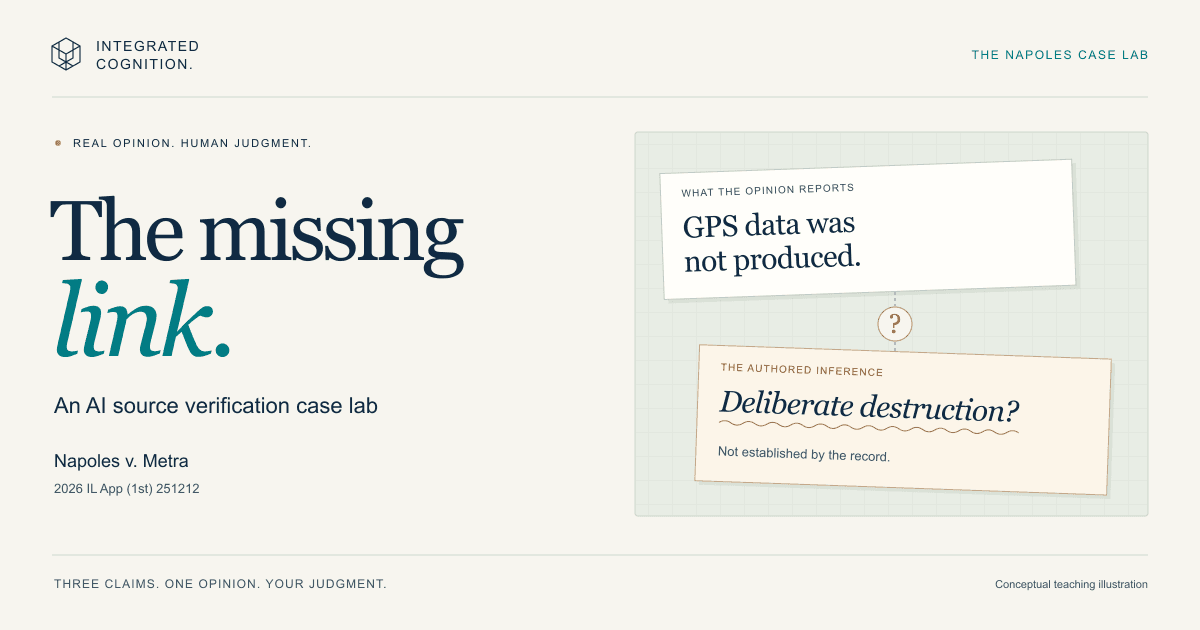
Follow the claim back to its source
An accurate citation does not make every conclusion attached to it accurate. Inspect three practice drafts about a seatbelt, missing GPS data, and an investigation. Compare each draft with the opinion, identify the unsupported leap, and choose a more defensible sentence. Then build a prompt that asks AI to preserve the distinction between what a source establishes and what remains uncertain.
What the court decided
Daniel Napoles sued Metra under the Federal Employers’ Liability Act after a collision involving a Metra pickup truck. The trial court granted partial summary judgment on the seatbelt and airbag allegation; other negligence claims proceeded to a jury, which returned a verdict for Metra. The appellate court affirmed. Its analysis of the seatbelt concerned evidence of notice, and its treatment of the missing GPS data and investigation evidence included cumulative-evidence and prejudice reasoning.
Read the procedural history, ¶¶8–13 and 26.
Read the disposition, ¶¶61–62.
A real opinion. An authored teaching exercise.
The source is Napoles v. Northeast Illinois Regional Commuter R.R. Corp., 2026 IL App (1st) 251212, filed October 30, 2026. The court did not address AI. Integrated Cognition prepared the practice drafts and feedback with AI assistance; they are teaching examples, not recorded model responses or performance findings. This exercise uses the appellate opinion, not the complete trial record. Jonathan Nessler’s legal review is pending.
