Jev is an AI model from TypeSafe AI that evaluates information and returns structured decisions: a selection from defined options, a position on a rubric, or an estimated probability that a statement is true. Its intended output goes directly into software rather than becoming a paragraph someone must read. TypeSafe announced Jev’s early-access release on September 15, 2026. TypeSafe’s launch announcement
For a lawyer, the useful starting point is an inbox. A new message may need to reach a practice group, receive an urgency flag, or enter a review queue before anyone drafts a response. Those preliminary judgments are small, but they accumulate across a firm. Jev offers a way to evaluate them within a controlled workflow.
Understanding that role requires more than knowing that Jev is fast. It requires understanding what the model receives, what its numbers mean, and who retains authority over the next action. This guide explains the technology first, then applies it to legal operations. The examples are proposed workflow designs, not reports of validated Jev deployments in law firms.
What does TypeSafe mean by a System One model?
TypeSafe uses “System One” for models designed around quick, bounded judgments. Jev is its first public model in that category. The company describes a specialized architecture and training approach called Reinforcement Learning for Calibrated Decisions, or RLCD. Those are the vendor’s descriptions of its approach, not evidence that the model understands a legal matter as an attorney does. Launch and training overview
Think about the difference between identifying which filing cabinet contains a document and explaining why that document changes a litigation strategy. The first task can often be framed with a finite set of answers. The second may require research, competing interpretations, and a written argument. A decision model is most interesting when the first kind of task appears repeatedly inside a larger process.
“System One” is therefore a useful product description, not a legal standard or proof of human cognition. The practical question is whether a specific judgment can be defined clearly enough to evaluate, tested against reliable examples, and connected to an appropriate next step.
How Jev works: state, questions, and software control
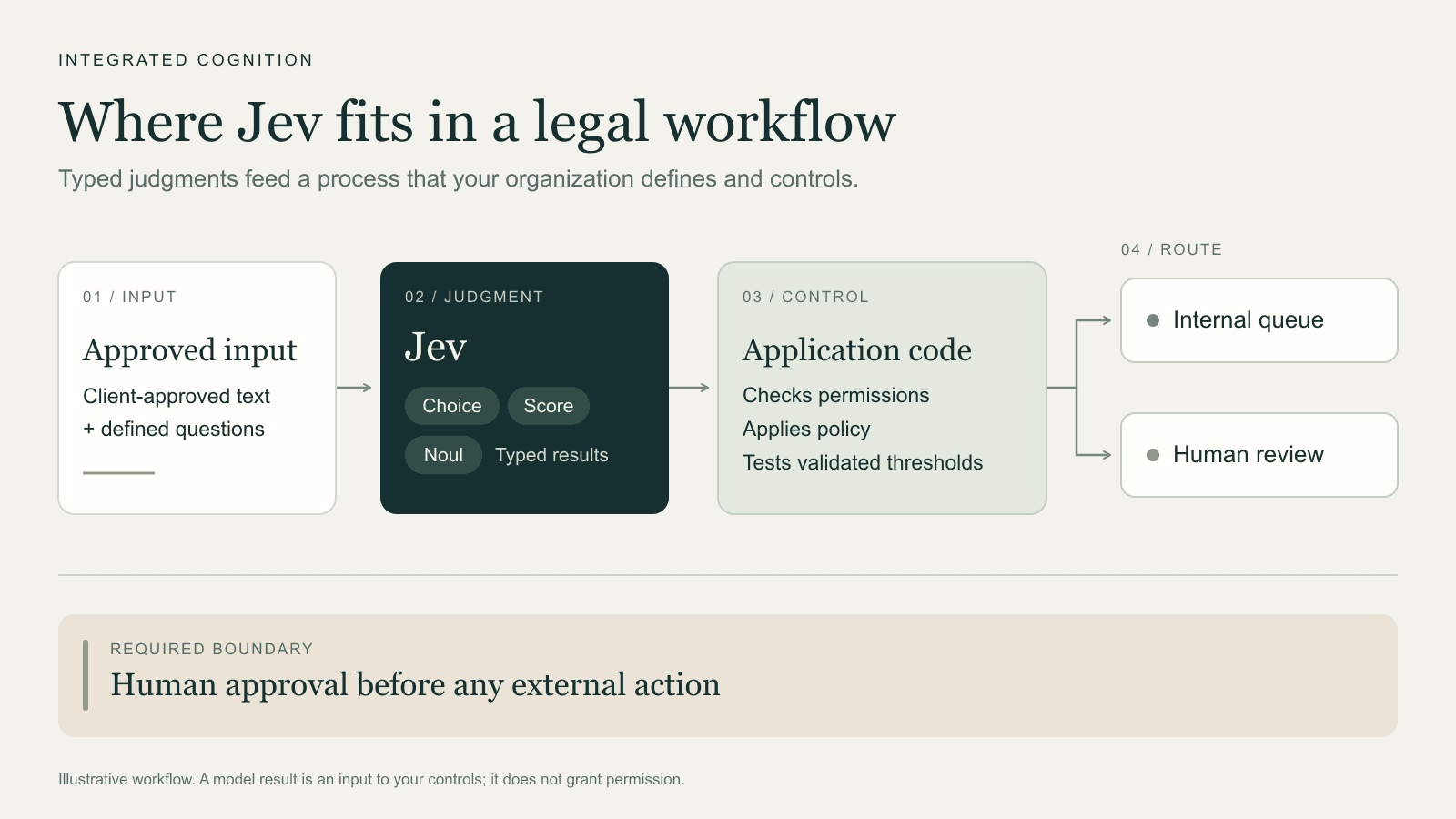
An application sends Jev a state and one or more typed questions. State is the information being evaluated: perhaps an email, selected contract language, or a structured record. The questions supply the task and answer criteria. Jev evaluates each question separately against the supplied state and returns results keyed to those questions. TypeSafe supports mixing its three question types in one request. Jev’s documented interface
Questions in the same call do not see one another’s answers. If a later judgment depends on an earlier result, combine results in code or make a follow-up call. Primitives documentation
Jev currently accepts text, including text supplied in JSON objects or arrays. Images, audio, and video require preprocessing; a scanned document needs text extraction before evaluation. Developers connect through TypeSafe’s client libraries or its POST /v1/systemone API endpoint. Models reference
An example state might contain the text of a prospective client’s inquiry, the relevant intake categories, and a limited set of matter details. One question asks which team should review it. Another asks whether the message expressly mentions an approaching hearing. A third rates how complete the submission is.
The application then decides what to do. It can add a label, place the inquiry in a queue, or request human review. Connecting Jev to email, a document system, or a case-management platform still requires integration work. A model response does not itself establish permission to access a matter or contact a client.
Choice, Score, and Noul explained
The three primitives answer different kinds of questions. Choosing the right one makes the output easier to interpret.
Swipe sideways to see all columns →
| Primitive | Question shape | Documented result | Illustrative legal use |
|---|---|---|---|
| Choice | Which defined option fits? | Selected option, probabilities for the options, and confidence | Select an intake review queue |
| Score | Where does the input fall on ordered descriptive levels? | Weighted score, level probabilities, confidence, and a level legend | Rate submission completeness |
| Noul | Is this statement true of the supplied state? | A value from 0 to 1; no separate confidence field | Flag language requesting urgent attention |
Choice: selecting among defined alternatives
A Choice returns the option with the highest probability and the distribution across the available options. The options need descriptions that distinguish them. If none may fit, the set should include a meaningful fallback. Choice documentation
For intake, a firm might define commercial disputes, employment matters, estate planning, and manual triage. “Manual triage” should cover mixed requests, missing information, and matters outside the firm’s categories. It should lead to an actual person or queue. Otherwise, an apparently complete taxonomy merely forces uncertain inquiries into the wrong department.
These labels are operational destinations. Selecting “employment matters” does not establish a viable employment claim, complete a conflicts check, or create an attorney-client relationship.
Score: rating against a descriptive rubric
A Score uses ordered descriptions rather than an unexplained numerical scale. Its returned number is the probability-weighted average of the level positions, starting at zero. A three-level rubric therefore spans 0 to 2. The response also includes the probabilities and a legend connecting positions to descriptions. Score documentation
Suppose an intake rubric has three levels: insufficient to identify the request; enough to identify the request but missing essential details; and enough for an initial human review. A fractional score expresses a position across that rubric. It is not a percentage of required fields completed or a probability that counsel should accept the matter. Count objectively required fields in ordinary software.
Noul: estimating whether a proposition holds
Noul returns an estimated probability between 0 and 1 for a true-or-false proposition. The documented output has no additional confidence field. The application decides what numerical threshold, if any, changes its behavior. Noul documentation
“The message explicitly requests a call today” is a much narrower proposition than “This matter is urgent.” The latter mixes time, potential harm, client expectations, and legal judgment. Good question design exposes those differences instead of compressing them into one authoritative-looking number.
Probability, confidence, and calibration are different
Probability assigns weight to an answer. Confidence, in Jev’s Choice and Score responses, summarizes how concentrated the returned distribution is. It is not interchangeable with the winning option’s probability and is not a measured accuracy rate. A confidence value of 0.93 does not establish that 93 percent of comparable legal decisions will be correct. TypeSafe’s confidence explanation
Calibration asks whether probabilities correspond to observed outcomes across comparable cases. As an illustrative test, take many independently reviewed examples assigned probabilities near 0.8 to a particular label. Does that label prove correct roughly 80 percent of the time? That is an empirical question, and it needs enough examples to make the comparison meaningful.
The distinction affects deployment. A firm cannot choose a threshold because the number looks reassuring. It must evaluate the exact question, labels, model version, and document population it plans to use. A threshold that performs well for routing invoice questions says little about withholding documents on privilege grounds.
A useful evaluation also distinguishes uncertainty from missing evidence. If an attachment was omitted or the relevant playbook was never supplied, the workflow may need to stop before a model score matters at all.
How Jev differs from chatbots, structured outputs, and rules
The decision to use Jev should begin with the job. A chat interface, a generative model with constrained outputs, a classifier, and ordinary application rules can all contribute to an AI system. Their suitability depends on the information available and the behavior required.
Swipe sideways to see all columns →
| Approach | Useful role | Question to resolve before adopting it |
|---|---|---|
| Deterministic rules or code | Exact calculations, access checks, known field validation | Can the requirement be expressed reliably without a model? |
| Traditional classifier | Repeated labeling within an established domain | Is there enough representative labeled data and an effective maintenance process? |
| Generative model with structured output | Producing structured answers within a broader generative workflow | Does the constrained answer remain accurate, efficient, and well supported? |
| Jev | Bounded judgments expressed through Choice, Score, or Noul | Do its results and uncertainty signals work on this firm’s actual task? |
It would be misleading to suggest that every generative workflow relies on asking politely for JSON and hoping for the best. Structured-output implementations can constrain response format. The meaningful comparison is broader: semantic accuracy, uncertainty, latency, operational complexity, and total cost.
TypeSafe markets Jev as avoiding hallucinations because its normal interface does not generate free-form text. That needs a narrow reading. Preventing an invented paragraph does not prevent a wrong classification. The model may select an allowed answer that the evidence does not justify. TypeSafe’s product description
For legal work, a correctly shaped wrong answer may be especially easy to automate. A queue label or Boolean-like result can pass through a system quietly. Review design must therefore assess the consequence of the answer, not just whether the response fits its expected structure.
Where law firms could use Jev
The following applications are hypotheses for testing. Start with an internal, reversible task where a reviewer can see the original information and correct mistakes.
Intake routing and completeness review
Jev could suggest a practice-group queue, identify a request needing prompt human attention, and rate whether the inquiry contains enough detail for intake staff. Keep the original message available and make reassignment easy. Use measured routing performance to determine whether any narrow category qualifies for automation.
Conflicts checking remains a separate process involving the firm’s records, identity resolution, and professional judgment. Recognizing an adverse-party reference in an email cannot establish that a conflicts search is complete.
Contract playbook triage
A contract team could supply a clause and approved playbook positions, then ask which review track fits. Labels might mean standard-language review, fallback-position review, or specialist escalation. They need definitions tied to the relevant transaction and current playbook.
Keep the label distinct from authorization to accept the clause. Materiality may depend on provisions elsewhere in the agreement, client instructions, and negotiation history. When that context is required, a clause-only classifier is evaluating an incomplete problem.
Discovery issue coding and review prioritization
A litigation team could test Jev on narrowly defined issue tags or reviewer queues. The evaluation should include representative document families, ambiguous examples, and the documents most likely to expose costly misses.
A privilege-related flag should remain a review aid. Deprioritizing apparently routine material can still affect whether an important document receives timely attention. Neither a high-confidence “business” classification nor a low privilege probability should become an automatic release instruction. A defensible review process needs its own legal and technical validation.
Diligence and questionnaire triage
An operations team could match a question to an approved answer library or route it to a subject-matter owner. This is useful when many incoming requests refer to the same policies using different language.
The system should distinguish locating a possible answer from certifying that the answer is current and applicable. A match to a security control is not proof that the organization implements that control. Assertions sent to a client or counterparty still need an accountable owner.
Reviewing proposed AI-agent actions
A firm using AI agents could evaluate a proposed action for signals that warrant review: an external recipient, a sensitive source, or a request inconsistent with the task. The model’s role would be advisory within an independently enforced permission system.
For Jev 1.13, TypeSafe specifically documents that adversarial content in the supplied state can steer answers. That makes it unsuitable as the sole security barrier between an agent and consequential actions. Credentials, allowed tools, recipient restrictions, and approval gates belong in controls the classification cannot override. Jev 1.13 documented limitations
A worked example: routing an inquiry without accepting a case
Consider this fictional inquiry: “Our supplier stopped delivering, and we have a hearing next week. Can someone call me today?” The example contains no client information, and the outcomes below are design choices, not a Jev benchmark.
- Prepare the input. Supply the inquiry and the firm’s intake-routing criteria. Check that the text is present and that the workflow is authorized to process it.
- Ask separate questions. Use Choice for the review queue, Noul for an explicit request for same-day contact, and Score for intake completeness. Do not ask for the merits of the dispute.
- Apply the firm’s policy. An asserted hearing or incomplete information can require staff review regardless of the suggested queue. Set any automated-routing threshold using validation-set results, then verify it on a separate held-out test set.
- Take a limited action. Place the inquiry in an internal queue with the original message attached. A staff member verifies the hearing information and follows the established intake and conflicts procedures.
- Record the outcome. Preserve the model result, applicable policy version, reviewer correction, and routing event with appropriate access and retention controls.
This workflow is useful even if the model never sends a message. Success means the right person sees the inquiry sooner with fewer manual sorting steps. It does not mean the system has evaluated jurisdiction, calculated a deadline, or agreed to representation.
Jev pricing, speed, and the actual cost of a workflow
As reviewed on September 19, 2026, TypeSafe lists $42 per billion input tokens, equivalent to $0.042 per million, with free output. TypeSafe’s model pricing
Its published speed comparisons concern its chosen workloads and comparison models. Treat those as vendor measurements, not a guarantee of law-firm performance. Launch performance comparisons
At that input rate, 100 million billable input tokens would cost $4.20. That calculation illustrates the advertised unit price only. Actual usage includes the supplied state and question material, and a real workflow also incurs integration, storage, evaluation, monitoring, and human-review costs.
The operational metric should be cost per correctly handled item at the required service level. A cheap call can create expensive rework. A fast response can still be slowed by document retrieval, redaction, network delays, retries, or waiting for a reviewer. Measure ordinary and slow-end response times across the whole workflow.
Lower unit costs can make previously uneconomic checks practical. They can also encourage teams to run unnecessary questions on excessive data. Add a decision because it improves the workflow, then measure whether the improvement survives implementation.
Known limitations that matter in legal work
TypeSafe’s version-specific notes for Jev 1.13 describe unreliable counting and date comparisons, difficulty with indirect instructions, declining accuracy with irrelevant context, and inconsistencies between differently framed questions. These are documented limitations of that version; future releases need fresh evaluation. Jev 1.13 limitations
The implementation consequences are concrete. Calculate deadlines and amounts with validated code and the relevant legal rules. Keep questions direct. Supply enough context to answer the question without burying it in unrelated material. Treat a change in question type or wording as a change worth testing.
A model’s structured result also does not provide a legal rationale. If someone needs to understand why a document was withheld or a clause escalated, retain the source material, criteria, and human reasoning needed for that review. An output label and probability alone cannot explain a legal conclusion.
Privacy, deployment, and professional responsibility
Jev’s documented integration uses TypeSafe’s hosted API. Its privacy policy states that services are hosted in the United States and that customer input is not used to train or fine-tune models. Its legal documentation separately says zero data retention is available for enterprise customers and links to a data-processing addendum and master customer agreement. Those statements do not establish that a particular account has zero retention enabled. Privacy policy, legal documentation
Before sending matter information, establish the terms that actually govern the intended service and account. Review retention and deletion, subprocessors, access, incident handling, regional requirements, and contractual commitments. If a client requires an on-premises or private-cloud deployment, confirm availability and terms directly; this guide does not establish that either is offered.
Use synthetic or properly authorized material while assessing the integration. Redaction can help reduce exposure, but removing names alone may leave a matter identifiable. Retain only the input and audit evidence needed for the approved purpose.
The ABA’s Formal Opinion 512 addresses generative AI and discusses competence, confidentiality, communication, supervision, candor, and fees. It is a useful starting point for reviewing AI governance, but it is not a Jev-specific opinion or a substitute for applicable jurisdictional rules and client obligations. ABA Formal Opinion 512
For a decision workflow, assign a responsible owner, identify which outcomes require attorney review, and document when the system must stop. These decisions belong in the operating procedure before a model is given access to consequential work. Our guide to understanding and using AI responsibly provides broader context for that responsibility.
How to run a meaningful Jev pilot
A good pilot tests whether a clearly defined process improves under real constraints. It should compare Jev with the existing workflow and any simpler alternative that could do the job.
- Choose one decision. Start with an internal routing task. Write down the allowed outcomes, the missing-information path, and the action each outcome permits.
- Create reviewed examples. Use synthetic, public, or appropriately authorized records. Have domain reviewers label them, resolve disagreements, and record genuinely ambiguous cases.
- Separate tuning from evaluation. Develop questions on one set; preserve a held-out set for final measurement. Split by matter or document family where needed to avoid nearly identical material appearing on both sides.
- Measure consequential errors. Report per-class precision and recall, especially misses in the category that requires escalation. Overall accuracy can conceal failure on rare but important cases.
- Evaluate probability quality. Compare probability ranges with observed outcomes. Measure how error rates and the share of automatically routed items change as thresholds change. Include enough rare cases to support the intended use.
- Set policy before live automation. Define acceptable error limits and mandatory-review categories before examining final test results. Tune thresholds on validation data, then check the frozen design on held-out data. There is no universal safe cutoff.
- Test failure handling. Include missing attachments, adversarial text, mixed requests, timeouts, and malformed or unexpected responses. A service failure should produce a reviewable queue item, not permission to proceed.
- Run in shadow mode. Let the model suggest outcomes while the existing process remains authoritative. Compare corrections, turnaround time, and total reviewer effort before granting limited autonomy.
- Version and monitor. Record the model identifier, question and policy versions, response, action, and reviewer result. Keep protected source references or authorized snapshots; a hash alone cannot reconstruct the input. Reevaluate after model, label, or workflow changes.
This process may show that Jev saves time, that an ordinary rule works just as well, or that the proposed judgment is too ambiguous to automate. All three are useful findings. The pilot succeeds when it produces evidence for a decision, even if that decision is to keep the task with a person.
Common questions about Jev AI
Can Jev draft a brief or research cases?
Its documented interface is designed for typed judgments rather than open-ended writing. A legal workflow that needs research and drafting still needs suitable tools, reliable sources, and substantive review. Jev may evaluate a bounded part of that workflow. Jev introduction
Does a schema-valid answer mean a correct answer?
No. An allowed category can still be wrong. Response validation checks the shape of the answer; evaluation against independently reviewed examples checks whether the judgment is useful. The two tests solve different problems.
Can a high score authorize a privileged disclosure or a filing?
A model score cannot supply authority that the firm, client, or applicable rules have not granted. Keep consequential external actions behind the approval and verification procedures established for that work.
Is Jev ready for every law firm?
Readiness depends on the proposed task, measured performance, governing terms, integration, and review capacity. This article presents a framework for evaluating those questions. It does not report independent legal-domain testing or endorse a production deployment.
What Jev changes about legal AI
Jev directs attention to work that happens between documents and decisions: sorting, prioritizing, matching, and escalating. Those steps deserve as much care as the drafting tools that receive most of the attention.
For a firm exploring the role of an agentic lawyer, the opportunity is to make each automated judgment explicit. Define the question. Preserve the evidence. Measure the error. Give software only the authority it needs, and make the path back to a person dependable.
The value of Jev will be demonstrated in that operating discipline: a better queue, a more consistent review process, or a useful reduction in routine work that leaves professional judgment with the people responsible for it.
